Showing posts with label research. Show all posts

Sunday, May 27, 2012

Due dates and other musings

So turns out there is a small, albeit vocal, following of this blog here in Dili (and yes, of course the family abroad are yelling out!) who implored me to keep writing.  While I realize the initial draw for most readers who were not somehow related to us, was perhaps something of the intrigue of the whole ordeal, and that - in all fairness, that has since pretty much worn off.  Which, after fourteen months, I have come to appreciate as a good thing.

Luka 22 March 2012,
Visalia CA
By way of a preface, I should point out that today, May 27th, is and was always supposed to be Luka's due date.  Of course, 'they' tell you that due dates are all a pile of smelly stuff, which in my enlightened state of pregnancy led me to respond to the big question with 'oh somewhere toward the end of May' - but secretly, every first-time pregnant woman hangs on to the notion of a due date like she last did for good weather on her wedding day even though 'they' tell you rain means good luck.

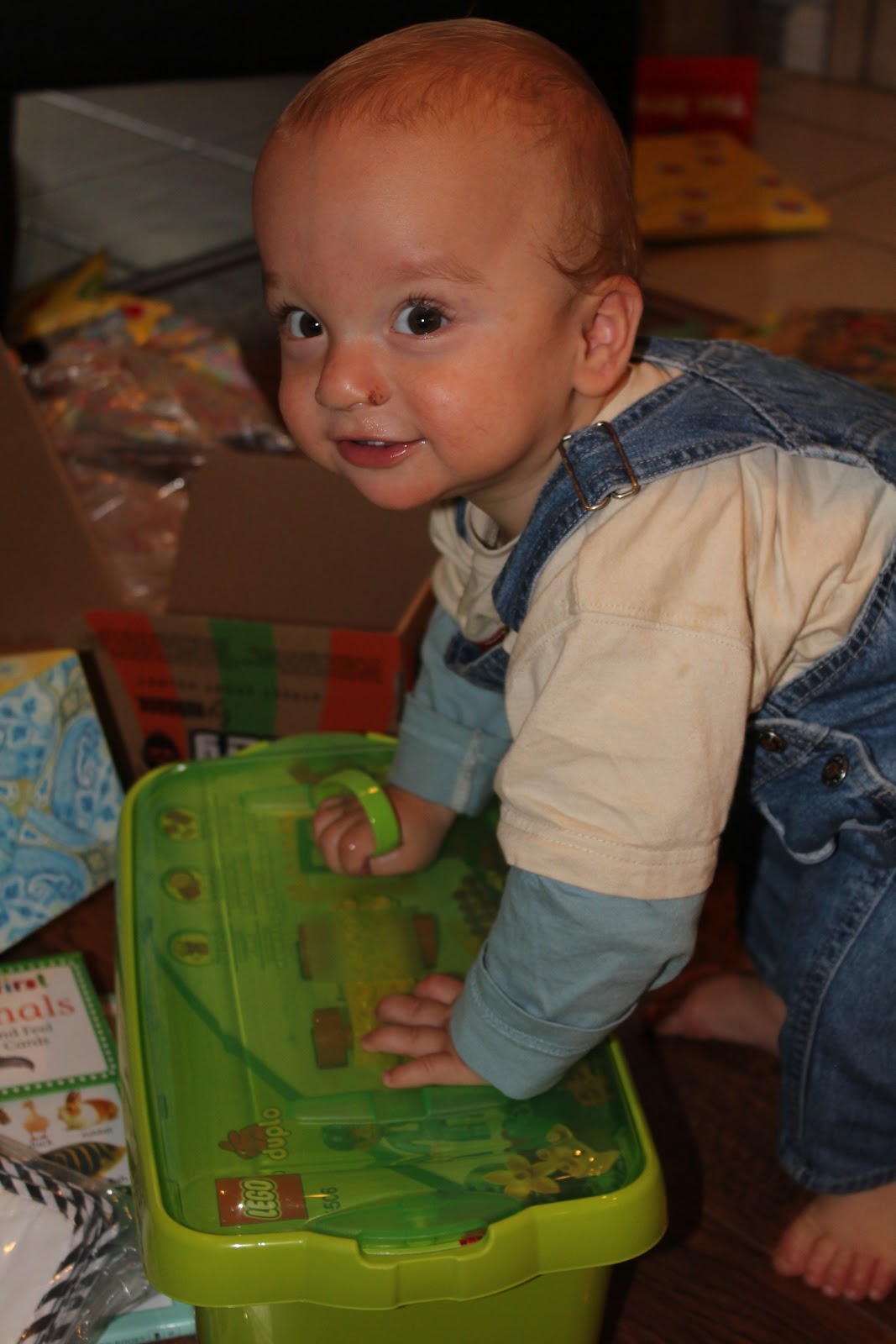
So, here we are, a whole two months and one week after we celebrated Luka's 1st birthday in the US with the extended US and South African families, and we have so much to be grateful for.  Chris and I recently reminisced about how much Luka has changed (matured if you will) in the past two months from this young man playing with his legos in grandma's house, to the toothy toddler rough-housing at today's bub club.

Luka, Dili 27 May, 2012
Of course, people point out what an amazing little creature he has become, and what a miracle the whole story is.  Which just reminded me once again over the past few days how incredibly, and indescribably fortunate we have been.  In thinking back to the dreadful day where we boarded a 70-minute flight to our future family, and measuring the difference between March 22 and May 27th, I am just blown away when I think of the whole thing one year ago.  I was not quite as able to take in the whole 'due date' anniversary last year as this day last year also coincides with the day that Luka was released from his second stint in the NICU, for his emergency surgery in Cape Town.

Consider that Timor-Leste, one of the poorest countries in Asia and where we currently live, is not the best place to be a child.  According to Save the Children, at least 54% of Timorese children under five have stunted growth due to malnutrition. In addition, it seems to me that most families I come across know first-hand the pain of losing a child(ren) at some point.  For most Timorese women, even the option of hospitalization is not always there, let alone one with the kind of care one would need for a premature birth.  My recent discussions and guidance to a colleague who's friend had a premature baby in the national hospital a few weeks ago and was being kept in a separate room in the hospital, away from the infant, with no instruction to touch, care for, or hold the small creature, alerted me to the breadth of support one needs in a situation such as the one we had.

Of course, I had a credit card and could access the internet to book a one-way ticket out of here.  I also had a US passport and health insurance to evacuate and get the care that my child seemingly deserved to give him the jump-start he needed.  As a result, I can't help but feel somewhat guilty when I bounce a healthy 11kg former preemie who more closely resemble 3-year old Timorese kids.  When I say 'guilty', I don't mean it in a melodramatic sort of way - but just that I can't imagine what I would have done without the caring instructions, guidance, support and encouragement I received from my midwives, pediatricians, nurses, lactation consultants and every other single person that guided us through that time in our life.

Today, we love watching Luka as he finally figures out this 'walking' thing, click his tongue, point to the light and hug our cat Gus.  I live for, and relish in his recent rediscovering of hugging and lap-sitting, especially at night, after his massage and bottle, when he decides he has had enough milk, hands me the bottle, sits up on my lap - throws his arms around my neck, and nuzzles his face, snuggling in secret  for a few seconds before pointing to his bed.

On his due date, all these many weeks after his actual birth date, I say a small prayer for all those who go into premature labor without the support network, care, encouragement and resources that I had at my disposal.  I also thank, once again, the doctors, midwives, nurses and administrators at the Royal Darwin Hospital in Australia, as well as my birth and antenatal coaches, and the staff and doctors at Vincent Palotti Hospital in Cape Town.  Luka is a product of his strong-willed parents, but he is also a testament to the difference world-class medical care make in our lives.
Wednesday, September 7, 2011

Staying Abreast

International Breastfeeding symbol


After struggling for six weeks to establish breast-feeding with Luka, and then regarding us as quite the team, imagine my disappointment and dismay this past week when I suddenly experienced a reduction in production.  Talk about a chicken-and-egg situation as the reduced milk stressed me out, while stress is one of the largest causes for a reduction in milk...

There are many reasons why this can happen, some of which include (yes stress) dehydration, a sudden increase in exercise (related to dehydration), certain medications, illness (I had a stomach bug that I forgot about), or having your period.

Needless to say having an exclusively breastfed baby with a reduced milk supply is not a nice position to be in, so we had to jump into action to get the 'ol puppies humming again.

So what is a girl to do.


  1. Feed more frequently
  2. Rent a pump to help stimulate production more - pump after each feed - if you are in Australia, I highly recommend the Medela Symphony II, we pumped about 1liter of milk per day in Darwin, if you are in South Africa, the best you can do is the Medela Lactina - it's no Symphony, but the strongest pump you will find - you can get it from a number of well-baby clinics around the country.
  3. Sleep or rest as you release more prolactin (the hormone needed for milk production) when you sleep (yes, this probably means getting some help to care for bub for a few hours so you can catch some zzzzz's)
  4. Hydrate, hydrate!  Water, tea, rehydration formulas, that sort of thing.  If you are in SA (or can get these at a healthfood store elsewhere), they recommended "Jungle Juice" to me, recipe: 
    60mls Schlehen Blackthorn Berry Elixir
    1 sachet Blackcurrant Rehydrate
    1L Apple Juice
    2L Water
    Add 10 drops rescue remedy per glass
  5. Herbal remedies - A variety of herbal supplements and remedies are believed to increase milk production: Fenugreek has been around since biblical times and Alfalfa (hold the cow jokes please!)
  6. Prescription medication such as Reglan (Metoclopramide) (US) or Domperidone (Motilium) (non-US). In South Africa they love to prescribe Eglynol which contains Sulpiride which I decided against after learning it is an anti-psychotic drug used for treatment of schizophrenia.  It is claimed to be very good for increasing milk supply though (and as I was told, with the added benefit of being an anti-depressant), talk to your healthcare provider to see whether this is necessary or even right for you and your baby. 

Tuesday, June 21, 2011

Books: What every new parent wants to know...

...how to <calm/properly develop/soothe/please> my newborn...

Alas, despite some much-more maternally-inclined parents out there than I, I doubt that there is a single mother (or father) for whom this new daunting experience comes completely naturally or pain-free.  As such, yes, I constantly find myself perusing Amazon.com and the local bookstores for assistance in the literary form.  While some books are clearly better than others, here are a few I have found useful to date.

1. Preemies (2nd Edition): The Essential Guide for Parents of Premature Babies by: Linden et al- This blog was never intended to give others advice but this one is seriously required - every parent of a premature baby should read this.  That is, unless of course you know what ROP, SBR, SRBs, inguinal, PU, BO and an incalculable number of other acronyms stand for - then sure, don't read it.  For the rest of us, order it, steal it, borrow it or beg for it if you have to, this book was truly a savior for us in Darwin and have since been a useful tool to friends of preemies as well.  Well written, informative, and easy to understand this daunting 656 page treatise of premature babies is compiled in a manner such that you only read the parts which pertains to you at any particular time.  Don't have twins - skip that section; never needed oxygen - move right along...but should you suddenly require unexpected surgery (insert throat clearing here), the section on What if my baby requires surgery - puts your mind at ease by explaining that a hernia surgery is the most common surgery performed on premature babies (insert sigh).
2.  The Happiest Baby on the Block: The new way to calm crying and help your newborn sleep longer  by: Dr. Harvey Karp (UCLA) - the purveyor of the notion of a calming reflex in babies - Dr. Karp will show you how to calm your colicy/screaming/generally unhappy baby in 5 easy steps.  As explained in this
older post, Dr. Karp believes that a human newborn is cheated out of a fourth trimester, and therefore needs his parents to imitate a womb-like environment to soothe them properly.  Easy to read, perhaps with a bit too much repetition between some of the chapters, though I get the point why, this book will teach you useful and necessary skills in soothing and calming even the most irate baby.  By carefully implementing the 5S's (swaddle, side/stomach, shhhhh'ing, swaying and sucking), or a combination thereof necessary for your own baby, you will soon have the tools to quiet even the loudest cries, and impress your family while doing so! (If you can, he has a video that shows you exactly how it is done - the term 'baby whisperer' does come to mind...) You can visit this Pediatrician to the stars online here
3.  Baby Love: Everything you need to know about your baby's first year by: Robin Barker  Australian nurse/mid-wife gives it to you straight.  This easy-to read, useful reference covers basics from pooing to burping (incidentally she believes there is way too much emphasis placed on the latter).  Use this to calm those frail nerves when your bub does not poo for a week (if you're breastfeeding - trust me, it is bound to happen)
4.  Baby Sense:  Understanding your baby's sensory world - the key to a contented child by: Megan Faure & Ann Richardson.  This most recent addition to my baby-library is a much thinner, and therefore quicker read and provides some very valuable insight into the need to control the sensory inputs for young infants.  If nothing else, it helped me understand the importance of enough sleep during the day for a newborn, if there is to be any hope of a good nights' rest.  The nurse/midwife and occupational therapist authors both specialize in 'fussy' babies and provide valuable advice not only in calming a fussy baby (helped me move Luka to his own cot), but also useful hints on appropriate ways to stimulate your infant in age-appropriate ways.  The book is divided into sections (First two weeks, 2-6 weeks, 6-12 weeks, and so on) with practical advice on how to stimulate vision, hearing, touch and other senses of your growing baby.  While I disagreed with a few of their suggestions (like stretching out feed times by giving a baby cooled boiled water), I found most of it very useful and enlightening and can recommend it for a new mom looking to understand the terms 'over-tired' and 'over-stimulated' as well as looking for tips on how to stimulate your bun's growing little brain.

More to come soon...off for a walk...


Wednesday, May 11, 2011

Kangaroo Care 2.0

Now that we are home with Luka, in our familiar environment, finally doing so many of the things we envisioned we would once our baby came - fix-its around the house, enjoying our first cool weather in over a year, and yes, lots of cooking - we can't help but realize Luka is not quite the vital newborn we anticipated two active, fit, and yes, big parents would have.  Instead, we are reminded by Luka, and experts in the field alike, that our little bundle of joy continues to require just that extra bit of attention, sensitivity and patience.

In researching the best ways to nurture and care for Luka, still three-weeks short of his due date, we are reminded of the importance of continuing the skin-to-skin or kangaroo care.  Renowned UCLA paediatrician and child development expert Dr. Harvey Karp, M.D, long-term researcher of colic in infants and subsequent purveyor of The Happiest Baby on the Block: The New Way to Calm Crying and Help Your Newborn Baby Sleep Longer,* argues that babies are really cheated out of a 'fourth trimester' and should therefore really be granted the same level of security, warmth and yes, touch and cuddling as they would normally enjoy in the womb - 'womb service' as he calls it. In his opinion, a newborn undergoes such dramatic development in the first three months of their life, evident in the marked difference between a fussy, crying, jerky newborn and a smiling, cute, engaging three-month old.  In reading this, I am once again reminded that the parents of preemies, even healthy ones, must beware to adjust expectations accordingly.  After all, Dr. Karp suggests that parents of 40-weekers beware and sensitive to the need for a womb-like environment, all the more so for the little ones who are still weeks away from their due date, such as Luka.

Aaah, enters that dreaded notion of spoiling the baby.  This concept so present in our western society where parents who pick up crying infants or otherwise see to their needs are quickly labeled as spoiling the infant.  As if someone that is not yet supposed to even be here has the critical thinking skills to come up with a cause-and-effect equation that favors his desires.  Even advocates for strict routine such as Tracy Hogg agrees that you should not try to treat your preemie as a normal (sic) baby until at least its due date.  Indeed, in her book Secrets of the Baby Whisperer:  How to Calm, Connect and Communicate with your Baby she claims that this is the only type of baby that should be allowed to demand feed and enjoy constant cuddling  What is interesting is that Dr. Karp  argues that even the term baby should be nurtured and not subjected to a strict routine until four months.

In our day-to-day dealings with Luka, and in getting to know his likes and dislikes, despite his amazing progress, it is still evident that he not simply wants, but needs closeness, warmth, security and yes, noisiness of the womb. To best accomplish this, we carry him in one of the many pouches we were gifted by our friends and family.  The lovely thing about these pouches are not only the comfort, but that the meters of fabric negates the need for wearing a shirt, and since Luka is only in a nappy, I figure that drastically cuts down on laundry!

Thanks to everyone who has sent us pouches, Amy & Darren, Rita, and Leana.  We really appreciate it, as does Luka!

Luka smiling from inside the organic "Sleepy Wrap"


* Also see Dr. Karp's website:  The Happiest Baby on the Block at: www.happiestbaby.com

Monday, May 9, 2011

My essential childbirth reading list...

Many of my expecting friends who know about my penchant for thoroughly researching everything I attempt have asked me for a reading list of books I found useful during my pregnancy, and particularly with the birthing process, I have been meaning to share this much sooner - but alas, everything going on kept me from posting this until now, I hope that it will at least be somewhat helpful to some of you.

Disclaimer - Chris and I decided early on that we wanted a very particular kind of birthing experience and subsequently focused our research on preparing for that particular experience. In no way do I imply that one way is better than another, rather I believe and hope that every woman should have the birthing experience that she wants.

Our approach...
Around the seventeenth week in the pregnancy, Chris and I finally came to terms with the whole idea that we were in fact pregnant.  I had obviously read some of the required pregnancy reading, none of which I found immensely interesting or useful, most of which I did not finish.  Instead, around this time in the pregnancy, I realized that these 'required readings'  spent way too much time on the pregnancy part, and not nearly enough time on the actual birthing process, except it seemed to discuss all that could go wrong.  This intrigued me, since it seemed that for a generally healthy, educated, non-smoking, logical person - that part kind of takes care of itself, and beyond the 'week-by-week' comparisons to beans and eventually fruits, there was little useful information you could not find with a quick Google search if you needed to. Instead, I started wondering about the decisions we make concerning the birth itself.

After my initial readings on pregnancy and childbirth I became fascinated with the negative connotation surrounding 'labor' and birth. Particularly what concerned me was the overwhelming fear associated with it.  Seemed to me that something that is so part of the natural life cycle, should not be as terrifying as the movies and other popular culture has made it out to be. Add to that the fact that the tight grip of private health care means that women were often not even given the option of a natural child birth, rather the whole process was being treated as some sort of medical intervention instead of the natural part of the life cycle that it is.  So I started reading and doing intense research on why and where this fear came from.  From there I re-focused my own research and preparation on reading texts I found presented childbirth in a positive light, as an intimate experience for mother, baby and birthing partner alike, instead of so many of the books that make it out to be some perverse and unnecessary act that would leave your beloved body forever altered and dignity in tatters. Through my readings I realized that what I was really after was a fear-free (note, not pain free)  'Active Birth' (one that allows the mother to move about freely, eat, use a birthing ball, shower, bath - whatever feels good - as opposed to a more medically-prescribed birth lying on the back on a hospital bed tied to monitors and other devices, watched by hordes of medical staff).

Further down the research process, I discovered HypnoBirthing by chance during an online search and after discussing my initial interest with Chris, I contacted the instructor in the Western Cape who came and did a home-class for Chris and I in January. I was admittedly skeptical, I mean Hypno-anything, we're yuppies not hippies for heavens' sake.  And if I was skeptical, imagine my logically-minded, scientifically-orientated beloved.  We decided to at least give it a go, and to see where it lead.  Without exaggeration, within the scope of 48-hours I had left my own fear of  'labor' behind in lieu of actually looking forward to the birthing process.  And yes, I can honestly say that it works.  I loved my birth and wished that I could do it again.  (More on this in the 'how it happened' installment to follow...)

So without further ado, books I found particularly useful during my preparation include:

  1. Active Birth: A new approach to giving birth naturally  - Janet Balaskas  - If you are considering a natural birth, I suggest reading this book first. It is approachable, more up to date than some of the older texts, and presents many useful tips on how to approach the experience including preparation for, and what to expect during birth.  She shares helpful tips on practicalities such as positions and natural pain relief.  Mostly she discusses the reasons for, philosophy for going this route.  
  2. Spiritual Midwifery - Ina May Gaskin - A classic must-read for a midwife-led natural childbirth.  It is a more dated text but critical to help us understand what a midwife is, and I particularly appreciated the personal accounts of child birth to get a sense of what you can expect, and how it can be done.  If you can read beyond some of the old colloquialisms like the constant use of 'lady' to refer to the women in the book, look beyond the fact that all those in the book did in fact live in homes that could move around, and stop giggling at the circa 1970s hairstyles and fashion, then this book, even only in part, will open your eyes to the way in which childbirth can be a bonding experience for both mother and partner.   The book has some good photographs and other art to prepare you and your partner, and also a complete guide to DIY childbirth at the back, should you find yourself in the unfortunate position of having to do this yourself on that Memorial Day camping trip in your 34th week. 
  3. HypnoBirthing: The Mongan Method, A natural approach to a safe, easier, comfortable birthing - Marie Mongan - The book, along with the training workshops, will introduce you to the notion of using deep relaxation techniques during the birthing process.  But moreover, it presents childbirth in a positive, (dare I say, enjoyable) light, as something to look forward to, and prepare for, instead of fear, dread and wish away.  Perhaps the most important contribution of this approach is the importance of the birthing partner as an advocate, supporter and part of the process.  (I saw this first-hand in Chris' active participation in Luka's birth in Darwin).  The use of affirmations and visualization is of particular importance as a technique currently used by almost every professional athlete in their own preparation for a winning performance.  The book is accompanied by a CD that contains a deep-relaxation (meditation-type) track and one with birthing affirmations (which I listened to on my daily exercise walks and incidentally used during my entire birthing in March). Perhaps not for everybody, but if you truly want a natural, un-medicated birth and (dare I say) enjoy it, I highly recommend at least trying it.  I am sure you can read the book and listen to the disc, but we found the course immensely helpful in allaying many of our fears about childbirth.  I have pretty strong views and thoughts on how HypnoBirthing helped me during my unexpected pre-term labor with Luka who came ten-weeks early. If you are pregnant and would like to chat about it, I'd be happy to give you my two cents - just drop a comment and let me know.
  4. The Mama Bamba Way: The Power and Pleasure of Natural Childbirth - Robyn Sheldon - This book by Cape Town midwife, this book is a more spiritual approach to the birthing process.  Drawing on both ancient traditions and with a heavy focus on women's innate wisdom and ability to accomplish a comfortable birth, this book also does wonders to allay the inherent fear factor surrounding child birth.  A tad on the spiritual side for me in the beginning (with Chakras and other things I am not that familiar with), but in the end a good read for the personal accounts and reaffirmations of the innate ability of a woman to birth the baby inside her (without unnecessary medical interventions).
Other books I had ordered and looked forward to reading during my final weeks of pregnancy, but never did because of Luka's pressing need to arrive in time for mothers' day include: 

  1. The Birth Partner, Third Edition: A Complete Guide to Childbirth for Dads, Doulas, and All Other Labor Companions
  2. The Baby Catcher: Chronicles of a Modern Midwife
The books contained in this list helped me to accomplish the birth that I really wanted.  Again, this is not to say that this is the right way, or that my way is better, rather that this is the way that I wanted to, and was fortunate enough to, experience birth.  I wish every woman the right and privilege of birthing her baby the way in which she wants to, however that may be.  I only wish we were not so pre-programmed to be afraid of this wonderfully empowering experience.